Introduction
George Jones never made love look simple. Long before the spotlight found him, he had already learned that affection was not something softly spoken across a dinner table. It was something shouted into a microphone, forced out through pain, shaped by a childhood in East Texas marked by hardship and violence. Born in Saratoga and raised in the unforgiving Big Thicket region, Jones grew up under the shadow of an abusive father who demanded volume, not vulnerability.
Music became the only language he could trust. It was where he said the things life never taught him how to express. When George Jones sang, heartbreak did not sound weak. It sounded honest. Regret carried weight. Love felt like something already slipping away.
Then he met Tammy Wynette.
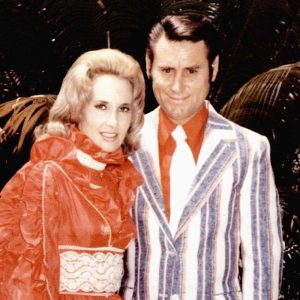
By the late 1960s, Wynette had already established herself as one of the most powerful voices in country music. Her songs carried emotional precision, often centered on heartbreak delivered with quiet dignity. When George Jones and Tammy Wynette married in 1969, the public did not just see a union. They saw a symbol. Two voices that could turn a duet into a conversation between wounded hearts.
Together, they became known as the “First Couple of Country Music.” Their performances were not staged illusions. Audiences believed every word because, in many ways, it was real. They sang about love, about holding on, and about the cost of staying when staying hurts.
But offstage, the harmony did not last.
George Jones struggled with alcohol and instability. There were missed performances, long absences, and broken routines. Fame amplified everything. Meanwhile, Tammy Wynette carried the dual burden of protecting a family and maintaining a career under constant public attention. The same emotional intensity that fueled their music began to erode their life together.
Eventually, the weight became too much.
Tammy Wynette filed for divorce.
From the outside, it looked like the beginning of a legal battle. There were shared assets, a brand, a legacy built together. Lawyers expected a fight. They advised George Jones to claim what was his. The house, the band, the touring bus. Half of everything they had created.
He refused.
“No.”
That single word defined the moment. George Jones chose not to turn love into litigation. He walked away, leaving everything behind. It was not the decision of a flawless man. By his own history, he was far from that. But it was a choice that carried more regret than pride, and that is precisely why it continues to resonate.
Some men fight to keep what remains. Others are remembered for what they let go.
After the divorce, a quiet image emerged that said more than any public statement ever could. George Jones got into his car and drove hundreds of miles from Alabama. He did not go to reclaim anything. He did not knock on the door.
He simply drove slowly past the entrance of the home that was no longer his.
No confrontation. No demand. Just a man circling the edge of a memory he could not enter anymore.
That moment has stayed with those who understand loss not as a single event but as a lingering presence. A house can be reassigned on paper, but the memories inside it remain inaccessible in a way that feels heavier than ownership. The act of driving past was not about property. It was about memory, about standing outside a life that once felt permanent.
It also explains why George Jones remained one of the most authentic voices in country music. He did not perform heartbreak as a concept. He lived it. He understood what it meant to love deeply and still fail the person you loved.
Years passed. Careers continued. Time reshaped the narrative, but it did not erase it.
Decades later, George Jones and Tammy Wynette stood on stage together again. The marriage was gone, but the connection was not. Audiences could feel it in the pauses, in the glances that said more than lyrics ever could.
There were songs and applause, but the most powerful moments came after the music ended. Silence filled the space where history lived between them.
At one of those moments, something was said quietly, just beyond the reach of the crowd.
“Some things are only meant for us.”
No one knows exactly what George Jones whispered to Tammy Wynette in those later years. It could have been an apology. It could have been gratitude. It could have been something too personal to ever be shared. What remains clear is that their story never truly ended with the divorce.
George Jones lost the house. He lost the marriage. But he never lost the music that carried both. And in that music, the story continues, unfinished, still echoing in every note that refuses to fade.