Introduction
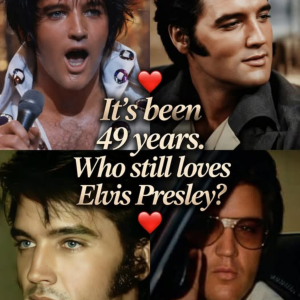
In 1956, American music stood on unstable ground. A cultural shift was underway, driven by a sound that emerged from Memphis and spread like wildfire across the nation. When Elvis Presley released Heartbreak Hotel, it was more than just a song. It became a defining statement of rebellion, echoing the restless spirit of a generation searching for identity and release. The record carried a dark energy, filled with tension and attitude, and it helped establish Presley as a global figure almost overnight.
Yet hundreds of miles away in Texas, a different interpretation was quietly taking shape. A young country singer named George Jones heard something else entirely within the same song. Where others heard defiance, Jones heard resignation. Where Presley projected distance, Jones recognized intimacy and pain. This contrast would mark one of the earliest defining moments in Jones’s career, revealing a rare ability to transform material into something deeply personal.
At the time, Jones was still finding his place in the industry. Signed to the independent label Starday Records and working under producer H.W. “Pappy” Daily, he was a young artist shaped by the rough realities of East Texas life. His voice carried the influence of countless honky-tonks and long nights, a sound grounded not in image but in experience. While Presley was rapidly becoming a national sensation, Jones was building something slower and more enduring, rooted in authenticity rather than spectacle.
The decision to record Heartbreak Hotel could have been dismissed as a simple commercial move. At a time when record labels were eager to capitalize on popular hits, covering a successful song was a common strategy. However, Jones approached the material differently. Instead of imitating Presley’s style, he stripped the song down and rebuilt it from the ground up.
The most immediate change came in the arrangement. Gone were the booming echoes, the driving rhythm, and the rock and roll edge that defined Presley’s version. In their place, Jones and his musicians crafted a sparse and emotionally restrained sound. The steel guitar carried much of the emotional weight, responding to Jones’s voice with drawn-out, mournful tones. The acoustic rhythm moved steadily, almost like a quiet pulse, guiding the song toward its inevitable conclusion.
This approach created an atmosphere that felt confined and intimate. The listener is not placed at a distance but drawn directly into the emotional center of the performance. The loneliness in Jones’s version is not suggested. It is present, immediate, and difficult to ignore.
Vocally, the difference between the two interpretations becomes even more striking. Presley’s delivery is controlled and distant, conveying a sense of cool detachment. Jones, on the other hand, sings as if he is living inside the story. His voice carries a trembling quality that reflects vulnerability rather than performance technique. Each phrase feels weighted, as though it is being experienced in real time rather than recalled.
One of the most revealing aspects of Jones’s artistry is his ability to internalize lyrics. He does not treat a song as something external. Instead, he approaches it as a lived reality. This quality was recognized early by those who worked with him.
George does not just sing songs. He lives inside them. When he sings about that lonely street, you believe he just walked out of it.
This observation from “Pappy” Daily highlights what set Jones apart even in his formative years. His interpretation of Heartbreak Hotel was not an imitation but a reinterpretation, one that revealed a different emotional truth within the same structure.
The recording became a turning point, not because it achieved the same commercial impact as Presley’s version, but because it demonstrated Jones’s unique artistic identity. He had the ability to take a widely recognized piece and uncover something deeper beneath its surface. This skill would later define his career and establish him as one of the most respected voices in country music.
In hindsight, the recording also offers a glimpse into the thematic direction Jones would pursue for decades. His work consistently explored themes of loss, regret, and emotional isolation. These were not abstract ideas but reflections of real human experiences, conveyed with a level of honesty that resonated across audiences.
Jones himself later addressed the perception that he was drawn to sorrowful material.
I am not more miserable than anyone else. I just feel it more, and sometimes I feel it for other people too.
This statement provides insight into his approach as an artist. His performances were not about exaggerating emotion but about accessing it in a way that felt genuine. Listening to his version of Heartbreak Hotel, it becomes clear that he was not only interpreting the song for others but also processing it for himself.
The contrast between Presley and Jones does not diminish either artist. Instead, it highlights the flexibility of the song itself. Presley built the structure, introducing a new sound that challenged expectations. Jones entered that structure and revealed its emotional core, offering a perspective grounded in lived experience rather than outward expression.
This duality speaks to a broader truth about music during that era. The same material could carry different meanings depending on the voice delivering it. In the hands of Presley, Heartbreak Hotel became a symbol of rebellion. In the hands of Jones, it became a reflection of quiet despair.
The legacy of this early recording extends beyond its immediate impact. It laid the foundation for Jones’s future work, including later recordings that would further refine his ability to convey complex emotional states. His interpretation style would eventually lead to songs that are now considered among the most powerful in country music history.
Looking back, it is clear that this moment was more than just a cover version. It was an early demonstration of a rare artistic instinct. Jones understood that loneliness was not just a theme but a language, one that could be communicated with precision and restraint.
While Elvis Presley introduced audiences to the world of Heartbreak Hotel, it was George Jones who invited them inside. His version did not rely on spectacle or innovation but on something far more enduring. It relied on truth.