Introduction
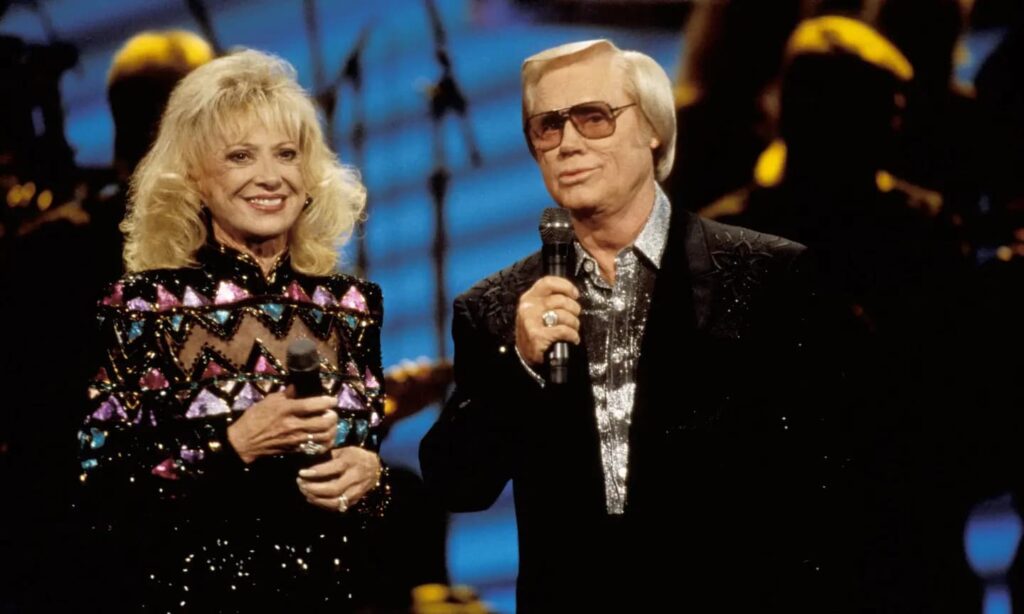
In the long history of country music, few partnerships have blurred the line between art and reality as completely as that of George Jones and Tammy Wynette. Their duets were not simply performances crafted in a studio. They carried the weight of lived experience, echoing arguments, reconciliations, and emotional scars that unfolded beyond the stage lights. For millions of listeners, the pair came to represent not only musical excellence but also a deeply human story of passion, conflict, and endurance.
Among their collaborative works, the song Even the Bad Times Are Good stands as one of the most revealing reflections of their relationship. It appeared on their 1976 album Golden Ring, released at a time when the couple had already divorced. The timing alone gave the record an unusual emotional gravity. Their marriage had officially ended in 1975, yet their musical partnership continued, raising questions and fueling public fascination.
The demand from audiences played a significant role in this continuation. Fans were not merely interested in the music. They were invested in the story. The narrative of a turbulent romance that refused to fade even after separation became inseparable from the songs themselves. As a result, Golden Ring became the only album by the duo to reach the number one position on the country charts, underscoring how personal turmoil translated into commercial and artistic impact.
The production of the album was handled by legendary producer Billy Sherrill, whose influence shaped the sound and emotional tone of the record. While the title track gained widespread recognition, Even the Bad Times Are Good emerged as a key piece within the album’s narrative. It did not chart as a single, yet its thematic weight resonated deeply with listeners familiar with the couple’s history.
The song itself challenges conventional ideas about love. Rather than presenting a polished image of harmony, it confronts the reality of conflict. The lyrics acknowledge arguments, tears, and public embarrassment, yet they insist that these hardships do not diminish the bond between two people. Instead, they become part of what defines and strengthens that connection.
“We sang what we lived, whether it was pretty or not,” George Jones once reflected, capturing the raw authenticity that defined their recordings.
Written by Carl Belew and Clyde Pitts, the composition offers a nuanced perspective on commitment. It suggests that enduring love is not measured by the absence of struggle but by the ability to withstand it. For listeners who followed the couple’s very public separation, the song carried an almost painful sincerity. It felt less like a performance and more like an attempt to make sense of a relationship that had both captivated and troubled the public.
The vocal interplay between George Jones and Tammy Wynette adds another layer of meaning. Jones brings a voice marked by vulnerability, often described as deeply emotional and unguarded. Wynette’s soprano, by contrast, carries strength and clarity. Together, they create a dynamic that mirrors conflict and reconciliation within the span of a single track.
“When we sang together, it was like telling the truth out loud, even when it hurt,” Tammy Wynette said in an interview, acknowledging the emotional intensity behind their performances.
This combination of voices transforms the song into something more than a simple duet. It becomes a conversation. At times, it feels like an argument unfolding through melody. At others, it resembles a quiet moment of understanding. The tension between these elements is what gives the track its lasting impact.
The broader cultural context also contributed to the song’s significance. During the 1970s, the personal lives of country stars were increasingly visible through media coverage. The struggles of George Jones with alcohol and missed performances became widely known, earning him the nickname associated with his unreliability on stage. At the same time, Tammy Wynette was often portrayed as resilient and composed, navigating both her career and personal challenges under intense public scrutiny.
This contrast between instability and strength fed into the narrative surrounding their music. Audiences did not just hear songs. They interpreted them through the lens of real events. In this sense, Even the Bad Times Are Good functioned as both a musical statement and a form of storytelling that extended beyond the studio.
The album Golden Ring itself reflects this duality. It captures the arc of a relationship that moved from union to separation, while still maintaining a creative connection. The irony of a divorced couple producing one of their most successful works together was not lost on the public. Instead, it became part of the album’s appeal.
For many listeners, particularly those with their own experiences of long and complicated relationships, the song offers a sense of recognition. It acknowledges that enduring partnerships are rarely simple. They involve compromise, conflict, and a shared history that cannot be easily separated into moments of happiness and pain.
Decades after its release, Even the Bad Times Are Good continues to be discussed as a defining example of how personal reality can shape artistic expression. It stands as a reminder that the most powerful music often emerges from genuine emotion rather than idealized narratives.
The legacy of George Jones and Tammy Wynette remains tied to this complexity. Their story is not one of perfect harmony, but of persistence in the face of difficulty. Through their recordings, they offered a candid portrayal of love that does not avoid hardship but instead confronts it directly.
As new generations discover their work, the questions raised by their music continue to resonate. What defines a lasting bond, and how much can it endure before it breaks, remains an open reflection carried quietly within the echoes of their voices.