Introduction
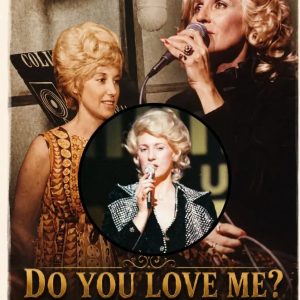
In the 1970s, a decade shaped by heat, defiance, and cultural shifts, Tammy Wynette stepped far beyond the polished walls of the Grand Ole Opry and into the raw, open fields of America. What unfolded in a recently rediscovered piece of footage captures more than a live performance. It preserves a defining moment when the artist known as the First Lady of Country Music asserted her place not through sorrow, but through power.
The scene is unmistakable. A vast crowd stretches under a simple canvas tent, restless and alive. Dust hangs in the air. Plastic cups of beer warm quickly under the relentless sun. This is not the refined acoustics of Nashville’s historic venues. This is unfiltered, immediate, and grounded in the spirit of the people who came to listen.
Then she appears. Tammy Wynette, dressed in a striking red gown, her signature blonde hair rising like a crown against the fading sky. The band strikes a steady rhythm. The pedal steel guitar cries softly while the drums maintain a firm, grounded beat. And when Wynette begins to sing, the atmosphere shifts.
The song is Your Good Girl’s Gonna Go Bad. But this is not just a familiar hit delivered for loyal fans. It is something sharper, more deliberate. Each lyric lands like a statement of independence. The performance reframes her image, moving beyond the sorrowful narratives that once defined her public identity.
For years, Wynette’s voice had been associated with vulnerability and emotional endurance. Songs like Stand by Your Man had cemented her reputation as a storyteller of loyalty and heartbreak. Yet on this stage, in front of thousands, she turns that narrative on its head. The lyrics carry a different weight. They speak not of submission, but of transformation and defiance.
“Tammy was not just performing for traditional country audiences at those festivals. She stood out there under the sun with rock fans, hippies, and working-class crowds, proving that emotional honesty in her music reached everyone,” said music historian Robert K. Oermann.
The band, known as the Countrypolitans, operates with precision while maintaining a looseness that suits the outdoor setting. The drummer, seated behind a kit labeled with the show’s name, anchors the sound with steady confidence. Around them, the musicians create a familiar country backdrop, allowing Wynette to take full command of the moment.
She moves with ease. A smile flashes across her face. She leans into the microphone with a gaze that balances playfulness and intent. At times, she bows slightly to the audience, a gesture that blends gratitude with authority. It becomes clear that she is not just performing within the space. She owns it.
The footage reveals the duality that defined Tammy Wynette. She embodies Southern femininity, yet her voice carries a strength that rivals any performer of her era. She is both the First Lady and a commanding force who understands the pulse of jukebox country and the expectations of a changing audience.
Removed from television studios and controlled environments, her true presence becomes unmistakable. There is no distance between artist and audience. The connection is direct and deeply human. Every note carries lived experience, and every movement reflects a performer who has endured and adapted.
“My mother loved those big outdoor shows. She thrived on that energy. On stage, she was not just singing about heartbreak. She was celebrating survival, and the audience could feel it in every note,” recalled her daughter, Georgette Jones.
That sense of survival is central to the performance. Wynette’s career had unfolded under intense public scrutiny, shaped by personal struggles, turbulent relationships, and the relentless demands of the Nashville music industry. Yet here, none of that diminishes her presence. Instead, it strengthens it.
The audience responds in kind. Straw hats tilt upward. Faces glow under the sun. There is movement, applause, and a shared recognition that something larger than a concert is taking place. The performance becomes a declaration. It is a moment where personal history transforms into collective experience.
Watching the footage decades later, the authenticity remains intact. The grain of the film, the texture of the sound, and the fashion of the crowd all contribute to its enduring impact. Nothing feels staged. Nothing feels distant. It is a direct window into a time when music carried the weight of identity and expression in its purest form.
This was not a reinvention. It was a revelation. Tammy Wynette did not abandon the emotional depth that defined her. She expanded it. She proved that vulnerability and strength could coexist within the same voice, within the same performance.
In that open field, under an unforgiving sun, she did not simply perform a song. She reshaped how her story could be told. The crowd did not just witness a concert. They witnessed an artist reclaiming her narrative in real time.
The image endures. A red dress against a dusty horizon. A voice rising above the noise. A moment where country music’s First Lady stood firmly as its reigning queen, not confined by expectation, but defined by her own resilience.