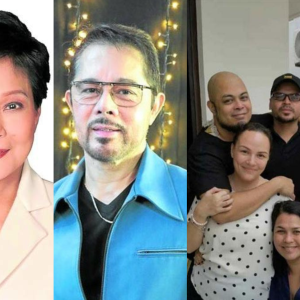
In the ever-churning theater of Philippine politics, where intrigue and indignation collide in a daily spectacle, another storm has broken over the national consciousness. This time, it was ignited by a searing interview between veteran broadcaster Ted Failon—affectionately known to many as “Manong Ted”—and controversial lawyer Levi Baligod, whose explosive allegations have sent shockwaves through the corridors of power.
At the heart of the controversy: claims of suitcase deliveries, whispered transactions, and the alleged involvement of high-ranking officials—including members of the Marcos political dynasty.
A Political Firestorm Rekindled
The drama intensified after Attorney Baligod presented a group of former military personnel who executed a joint affidavit alleging that millions in cash were delivered in suitcases to prominent political figures. The accusations were not minor. They named lawmakers, invoked former officials, and even suggested connections to international entities.
But what truly electrified the public was a pointed question raised during Baligod’s interview with Failon: Was Representative Sandro Marcos, son of President Bongbong Marcos, also a recipient of such deliveries?
The mere suggestion sent social media into a frenzy.
Failon, known for his measured yet piercing style, pressed Baligod on inconsistencies within the affidavit—particularly regarding details, specificity, and the inclusion of certain names. The interview was not hostile, but it was relentless. Each answer seemed to open another door of uncertainty.

The Affidavit That Shook the Establishment
The joint affidavit, signed by 18 former soldiers—16 reportedly from the Philippine Marines and two from the Philippine Army—alleged that they personally witnessed and participated in transporting large sums of money in suitcases. According to their statements, these deliveries took place in upscale locations, including private residences and exclusive properties in Metro Manila.
Baligod maintained that the affidavit was sufficient to establish “reasonable grounds” for investigation by the Office of the Ombudsman. He argued that the details intentionally withheld from public disclosure would be presented in full during formal proceedings.
But Failon zeroed in on the gaps.
Why were some individuals named specifically while others were referenced vaguely?
Why were certain addresses omitted?
Why did one portion of the affidavit include now-Representative Leila de Lima among “members of Congress” during a period when she was not yet serving in that capacity?
Baligod admitted that including de Lima under that category may have been an oversight. He insisted, however, that the core allegations remained intact.
For many observers, that admission became a turning point in the public debate.
Sandro Marcos: The Name That Echoed
Although Sandro Marcos was not explicitly detailed in the initial affidavit excerpts widely circulated online, commentators and online personalities began asking whether he—or any member of the Marcos family—had ever been linked to similar alleged transactions.
The speculation grew louder when footage resurfaced from past campaign sorties showing prominent politicians boarding private aircraft. Social media users drew their own conclusions, overlaying old campaign visuals with fresh accusations.
No formal evidence has been presented tying Sandro Marcos to any wrongdoing. Yet in the age of viral narratives, perception can move faster than proof.
The younger Marcos has maintained a relatively low public profile compared to his father. Representing Ilocos Norte’s first district, he has positioned himself as part of a new generation of leadership. Now, however, his name has been pulled into a maelstrom not of his own making.
The ICC Angle and International Intrigue
Adding another layer to the unfolding saga were claims involving alleged financial exchanges connected to individuals said to be linked with the International Criminal Court.
Some affidavits described peso-to-dollar conversions totaling tens of millions, supposedly intended for “foreigners” connected to ICC-related activities. Among those mentioned in the broader narrative was former Senator Antonio Trillanes IV, though he has not been formally charged in relation to these new allegations.
The ICC has long been a flashpoint in Philippine politics, particularly due to its investigation into former President Rodrigo Duterte over his administration’s war on drugs. Any insinuation that financial transactions were linked to international legal processes only intensified the political temperature.
For supporters of Duterte, the allegations against the current administration represent retaliation. For critics of the Marcos government, they symbolize continuity in alleged systemic corruption. For ordinary Filipinos, they are yet another chapter in a saga that feels both familiar and exhausting.
Media Under the Microscope
The controversy has also revived longstanding debates about media ownership and influence. Baligod suggested in the interview that legislative reforms might be necessary to limit politicians’ economic interests in major media organizations.
While he did not directly accuse specific outlets of complicity, the implication was clear: if political power and media power overlap, public discourse may be shaped—or suppressed—accordingly.
It is a sensitive subject in a country where journalism has historically been both courageous and vulnerable.
Legal Strategy or Political Gambit?
Baligod insists his actions are purely legal. He claims the affidavit’s purpose is to provide prima facie evidence sufficient for the Ombudsman to open a formal investigation. Details, he says, will emerge in due course.
Critics counter that the timing—amid geopolitical tensions, ICC developments, and domestic political maneuvering—cannot be ignored.
Was this a calculated release designed to destabilize?
Or is it a long-overdue reckoning brought forth by whistleblowers who could no longer remain silent?
Baligod rejects the idea that he is acting on behalf of any political faction. He acknowledged having known figures across the political spectrum but emphasized that he initiated contact with the former soldiers after observing what he believed to be unfair treatment of testimony in Senate hearings.
A Nation Watching Closely
The Philippines has weathered many political storms, from impeachment trials to corruption scandals that captured global headlines. The names may change, but the themes—power, loyalty, accountability—remain constant.
As of this writing, no charges have been formally filed against Sandro Marcos or other high-profile figures mentioned in online discourse surrounding the affidavit. The Ombudsman has yet to publicly announce the status of any investigation arising from Baligod’s submission.
What remains undeniable is the public’s appetite for answers.
On talk shows, radio programs, and livestream platforms, citizens debate not only the credibility of the witnesses but also the broader health of the nation’s institutions. Questions linger about transparency, due process, and whether the rule of law remains robust enough to withstand political crossfire.
The Stakes Ahead
If the Ombudsman proceeds with a formal inquiry, the implications could ripple through Congress and beyond. Witnesses may be summoned. Documents may be subpoenaed. Political alliances may shift.
For Sandro Marcos, the challenge is reputational. In politics, even unproven allegations can cast long shadows. How he navigates this period—whether through silence, transparency, or proactive clarification—could shape his trajectory.
For President Bongbong Marcos, the controversy tests both leadership and legitimacy. Critics will scrutinize every response; supporters will rally defensively.
For the Filipino public, the moment is about trust.
Trust in institutions.
Trust in media.
Trust in leaders.
A Defining Crossroads
The confrontation between Ted Failon and Levi Baligod was more than a viral interview—it was a snapshot of a democracy grappling with itself.
Failon’s probing questions reflected a journalist’s duty to challenge. Baligod’s measured responses reflected a lawyer’s strategy to reveal selectively. Between them lies a nation demanding clarity.
Will the allegations unravel into substantiated cases?
Will they dissolve under scrutiny?
Or will they linger in the gray space where suspicion survives but proof never fully materializes?
In Philippine politics, certainty is rare. But one thing is clear: the suitcase controversy has reopened debates about corruption, accountability, and the resilience of democratic institutions.
As the story continues to unfold, Filipinos at home and abroad watch with a mixture of skepticism and hope—hoping that whatever the truth may be, it emerges not through rumor, but through transparent, lawful process.
Because in the end, the future of any republic depends not on whispers in hallways or viral clips online, but on the strength of its institutions—and the courage of its people to demand integrity from those who lead them.