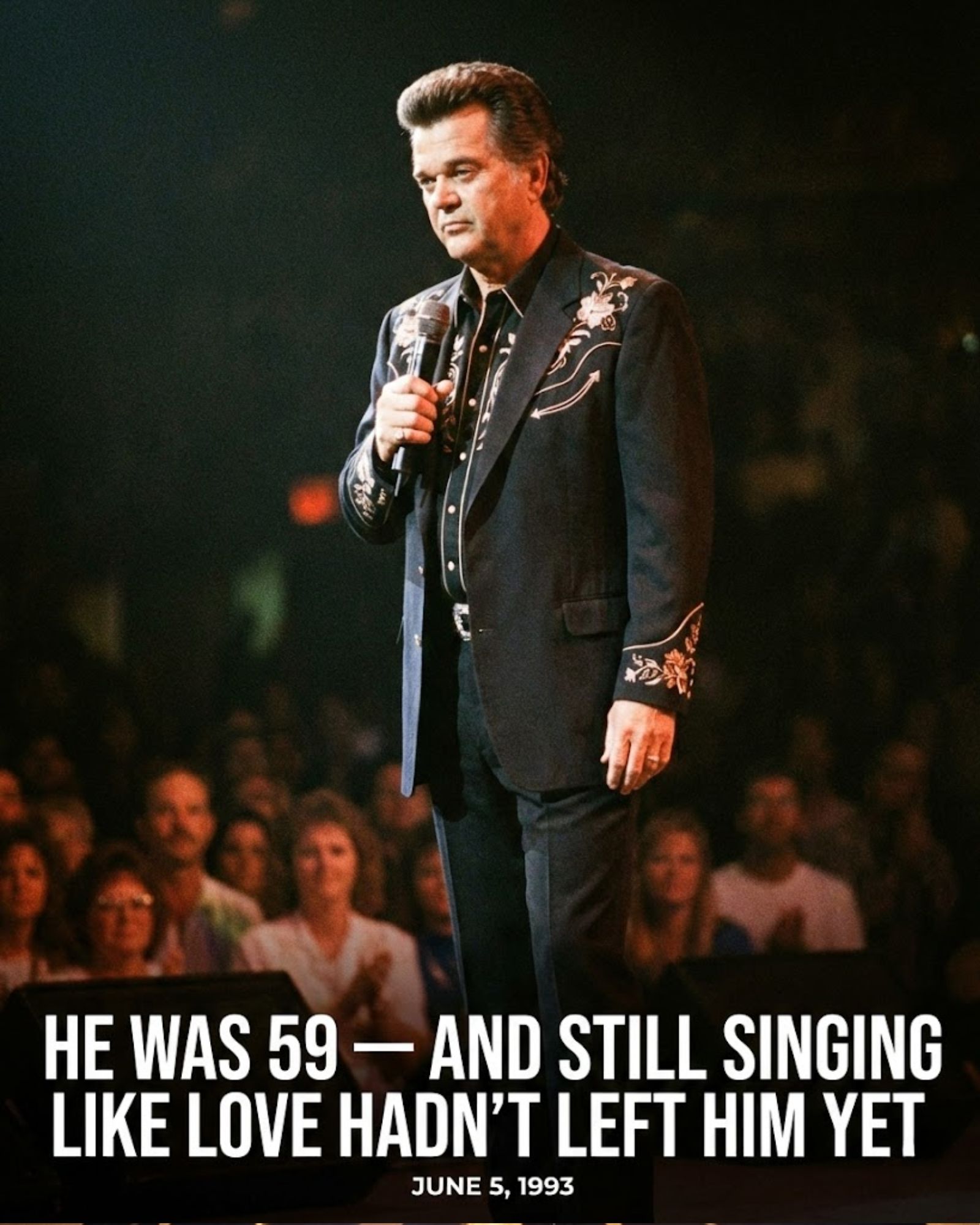
The Day Conway Twitty’s Love Songs Stopped Feeling Like Memories
There are a few voices in country music that don’t just play in the background. They sit with you. They ride along on late-night drives and fill up quiet kitchens when the house feels too empty.
Conway Twitty was one of those voices.
On June 5, 1993, country music lost the man many fans still call “the greatest male love singer in country music.” He was 59. He wasn’t retired. He wasn’t fading out. He was still working, still traveling, still walking onto stages like it was the most normal thing in the world to tell thousands of strangers exactly what heartbreak feels like.
When the news broke, it didn’t feel like an ending. It felt like someone turning off a light in the middle of a sentence.
A Career That Still Had Momentum
By 1993, Conway Twitty’s name was already stitched into the history of country music. Not just because he had hits—because of what those hits did to people. Conway Twitty didn’t sing love like a slogan. Conway Twitty sang love like a confession.
There was a certain steadiness in the way Conway Twitty delivered a line. The kind of steadiness that made listeners believe every word, even if they knew better. Even if they had already been hurt before. Even if they swore they’d never fall for the same kind of story again.
And that’s why his passing hit differently. Conway Twitty wasn’t a star from a distant era. Conway Twitty was still there. Still current. Still moving forward.
When the News Reached the Radio
People who were listening to country radio that day still describe the same strange feeling: a brief pause, almost like the stations themselves didn’t know what to say.
It wasn’t dramatic. It was worse than dramatic. It was quiet.
Then the music answered the only way it could—by playing Conway Twitty. Not a tribute montage. Not a long explanation. Just the voice.
One after another, the familiar titles returned like a row of porch lights switching on:
“Hello Darlin’.”
“It’s Only Make Believe.”
“Tight Fittin’ Jeans.”
Those songs didn’t land like old memories that day. They sounded present. Too present. Like he was still out there, about to walk back into the room and make everyone feel silly for panicking.
Why Those Songs Felt Like Final Words
There’s a reason Conway Twitty’s love songs cut so deep. They don’t beg for attention. They lean in close. They speak softly. They leave space for the listener to fill in the rest.
That space becomes dangerous when the singer is gone.
Because suddenly the lyrics stop being a performance and start sounding like a farewell—whether they were meant that way or not. A line that once felt romantic can turn into something heavier, simply because it’s the last version of that line you will ever get.
Some fans said it felt like Conway Twitty’s songs were doing the talking that nobody else could do. Like the radio hosts, the musicians, and the listeners were all standing in the same stunned silence, and the only person brave enough to speak was Conway Twitty himself—through recordings made long before anyone imagined this day would come.
“It didn’t sound like a throwback,” one longtime listener recalled. “It sounded like he was still alive somewhere, and the radio was the only place he could reach us.”
The Myth of “One Last Song”
People love the idea of a final message—a last performance that sums everything up. But most real endings don’t arrive with a perfect soundtrack. They arrive in the middle of life. In the middle of plans. In the middle of a tour schedule. In the middle of a sentence.
That’s why fans still ask the same question in different ways: Was one of those love songs meant to be Conway Twitty’s final goodbye?
There is no clean answer. Maybe the goodbye was never supposed to be planned. Maybe the goodbye was always hiding inside the songs, waiting for the day the voice stopped coming back.
What Stayed After the Silence
When a singer like Conway Twitty is gone, the world doesn’t stop. Radios keep playing. People keep driving to work. Dinners still get cooked. But something shifts anyway.
Because for the people who grew up with Conway Twitty—or leaned on Conway Twitty during a divorce, a long-distance love, a lonely season—his voice wasn’t just entertainment. His voice was company.
And on June 5, 1993, that company felt suddenly, sharply limited. Not erased. Not forgotten. Just no longer unfolding in real time.
Yet Conway Twitty’s songs kept doing what they always did: making a stranger feel understood in under three minutes.
That might be the strangest part. Even after the news. Even after the silence. Conway Twitty still sounded close enough to touch.
And maybe that’s why those songs still don’t feel like memories to so many people.
Maybe they still feel like a conversation that never truly ended—just paused, mid-sentence, waiting for someone brave enough to press play again.
