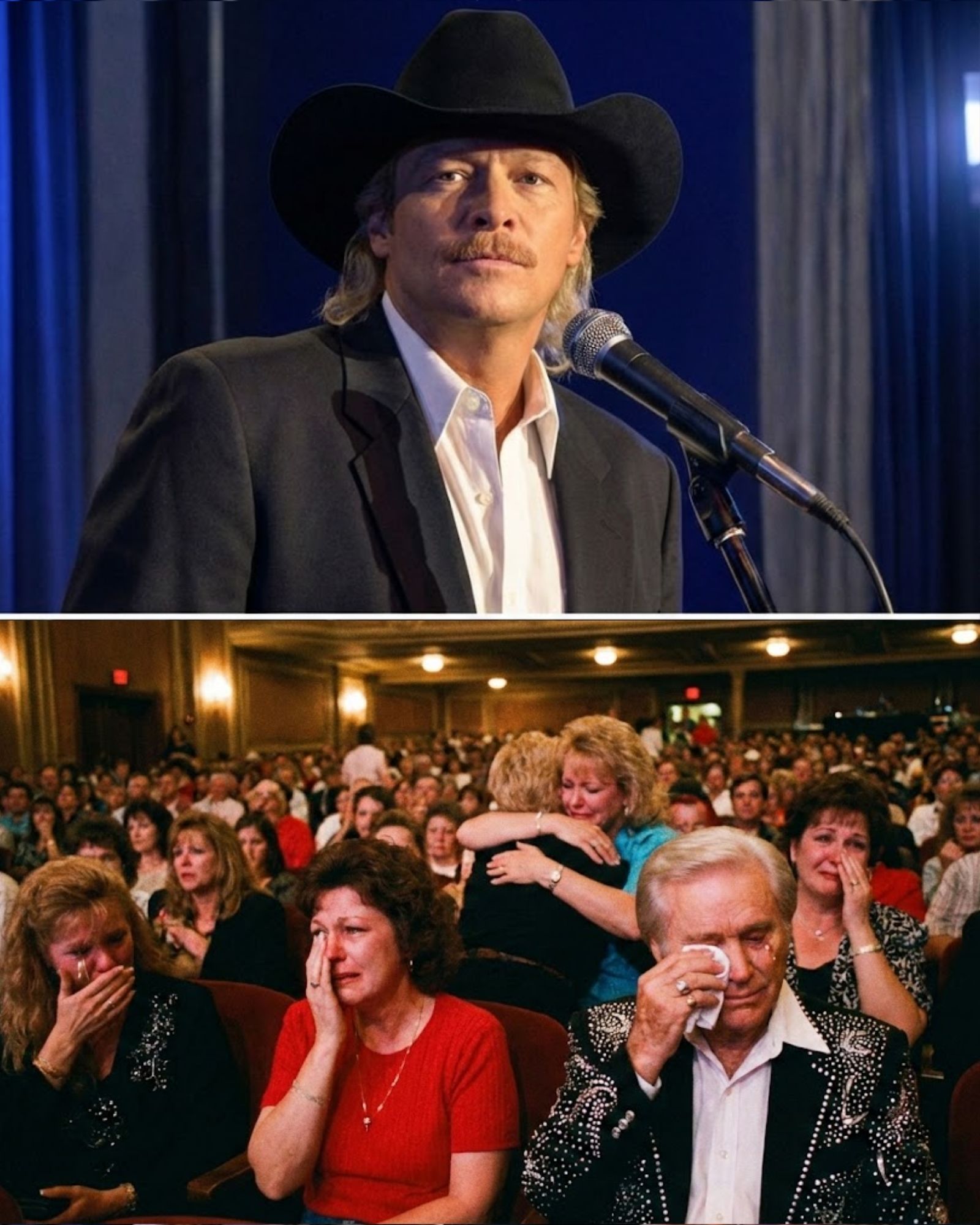
Alan Jackson Stopped His Own Song—And the Room Didn’t Know What to Do Next
The schedule for an awards show is usually treated like scripture. Every second is planned. Every camera move is rehearsed. Every performer is expected to hit the mark, smile, and keep the machine running.
That’s why the moment Alan Jackson stopped in the middle of his own performance still gets talked about decades later. It wasn’t loud. It wasn’t chaotic. It was almost calm—which somehow made it feel even more powerful.
The Night Was Timed to the Second
On a live awards night broadcast across America, the pressure backstage can feel like a weight on everyone’s shoulders. Producers count down transitions. Stagehands hold their breath. Musicians watch monitors like hawks. There’s an unspoken rule: do not improvise.
But on that night, something happened that rubbed a lot of people the wrong way. George Jones—already a legend, already a pillar of country music—was booked to appear. The plan, as many fans understood it later, involved George Jones performing only a shortened piece of his song “Choices.”
To the people running the show, it was a time issue. To many in the country community, it felt like something else: a lack of respect for a man whose voice helped define an entire era.
George Jones reportedly wasn’t comfortable with the idea. In the end, George Jones did not take the stage for that abbreviated spot. The show moved on, as shows always do.
Except Alan Jackson wasn’t done with it.
“Pop a Top” Began Like Everything Was Normal
When it was Alan Jackson’s turn, the atmosphere in the room had the usual excitement—fans ready to sing along, cameras ready to capture the highlight, the band locked in. Alan Jackson walked out and launched into “Pop a Top,” one of the songs audiences loved him for: steady, familiar, the sound of a barroom story told with a clear voice.
For a moment, it looked like the night would stay on script.
Then, halfway through, Alan Jackson stopped.
Not a stumble. Not a mistake. A deliberate stop. The kind of stop that makes a band glance at each other. The kind that makes the crowd make that small wave of noise—confusion, curiosity, a shared sense that something unexpected is happening.
And then Alan Jackson signaled for a change.
“Choices” Filled the Room
Suddenly, the melody of “Choices” began.
It was one of those moments where the meaning arrived before the explanation did. People in the audience recognized the song quickly. Even those watching from home could feel the shift: this wasn’t a medley anymore, not a quick tribute clipped down to fit a rundown.
Alan Jackson sang “Choices” as if he was handing it back to George Jones in real time. The performance carried respect, but it also carried something sharper—an edge that didn’t sound like anger for attention, but like frustration on behalf of someone who deserved better.
It was a quiet act of defiance, and it landed harder than a shouted speech ever could.
“Sometimes the most rebellious thing you can do is slow down and show respect.”
Backstage Reactions and a Crowd That Couldn’t Look Away
In stories like this, people always imagine the backstage panic. The producers watching their timers. The crew wondering if they should cut away. The director trying to decide whether to stay with the shot or protect the program.
But out front, the crowd was leaning in. It didn’t feel like a stunt. It felt like a line being drawn—one that said legends are not background decoration, and real country music doesn’t always fit neatly into a countdown clock.
The moment became part of awards-show history because it was simple: Alan Jackson used his own stage time to restore someone else’s dignity.
And What Did George Jones Think?
That question has followed the story ever since. People have repeated different versions over the years—some say George Jones was moved, some say George Jones looked stunned, some say George Jones smiled in that quiet way that didn’t need words.
What’s certain is this: the performance honored George Jones in a way the official plan didn’t. It was a public statement without being disrespectful, dramatic without being messy, and emotional without being sentimental.
Alan Jackson didn’t lecture anyone. Alan Jackson just sang the song that mattered—at full length, in the middle of live television—so nobody could pretend it wasn’t important.
Why the Moment Still Matters
Awards shows are built to move fast. Country music, at its best, is built to tell the truth—slowly enough for people to feel it.
That night, Alan Jackson reminded everyone that timing isn’t everything. Respect is. And sometimes, the most unforgettable performance is the one that refuses to stay in its assigned box.
Alan Jackson began with “Pop a Top,” but he ended with something bigger: a message that country legends like George Jones are not meant to be trimmed down to fit the clock.
