Nearly 3 decades after her tragic death, the late Princess Diana continues to make international headlines. Many questions remain about her final years, what happened the night she died and who may be responsible for the accident.
In Diana: The Ultimate Truth, former detective and award-winning investigative journalist Mark Williams-Thomas examines theories that have emerged since Diana’s passing and sets out to answer the key questions that continue to swirl around the late princess of Wales.
What impact did Diana’s revealing BBC interview have on the final years of her life? Could she have potentially survived her injuries from the crash? Was driver Henri Paul under the influence of alcohol that night? And had her car really been tampered with?
The interview that changed everything
In November 1995, two years before her death, Princess Diana agreed to a television interview with Martin Bashir from Panorama, the BBC’s flagship current affairs program. The revealing segment made headlines around the world after Diana exposed her and Prince Charles’s extramarital affairs.
As a result, the Queen urged Diana and Charles — who had been separated since 1992 — to divorce, and Diana was stripped of the title of Her Royal Highness. Her royal security was also removed.
New documentary
Historians believe the Duke of Windsor actively collaborated with the Nazis during the Second World War
How did Bashir, a relatively unknown BBC journalist, win this extraordinary interview and, crucially, Diana’s trust?
A graphic designer working for BBC later disclosed that Bashir had asked him to forge bank statements that showed a former employee of Earl Spencer, Diana’s brother, had sold stories to a U.K. national newspaper. Bashir then showed the falsified statements to Earl Spencer to gain his confidence; Spencer then introduced Bashir to Diana.
In Diana: The Ultimate Truth, Williams-Thomas speaks with Tom Mangold, a long-time Panorama reporter who caught on to the deception and raised his concerns within the BBC. “A friend of mine on the program … came to me and said, ‘Our graphics artist, Matt Wiessler, has told me that Martin ordered him to forge two bank statements,’” says Mangold. “And they were used to get the interview with Princess Diana.” He took his concerns to the program editor but was ignored.
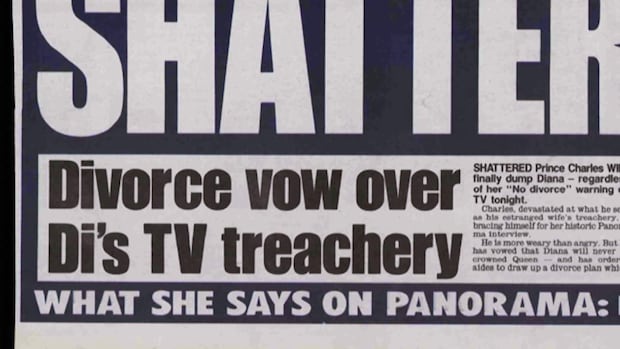
The interview that changed everything | Diana: The Ultimate Truth
Diana’s revealing interview with BBC reporter Martin Bashir made worldwide headlines, but that interview was obtained using lies and forged documents.
Five months after the interview aired, the Mail on Sunday newspaper revealed what Mangold knew to be true, but by then the damage of what Diana divulged was done.
Williams-Thomas also meets with Diana’s close friend Simone Simmons, who described Diana’s conversations with Bashir prior to filming the interview. “[Bashir] was talking about … did she realize, you know, she is surrounded by people who are betraying her?” says Simmons in the documentary.
“She said to me, ‘I didn’t know how many enemies I had.’”
‘I am going to [die] in an accident — helicopter, plane or car crash’
During his investigation, Williams-Thomas meets with other close friends and associates of Princess Diana, who describe a kind, strong-minded and thoughtful person. They also reveal Diana’s inner concerns in her final years.
Speaking publicly for the first time, security expert Grahame Harding explains how Diana feared her calls were being recorded and hired him to inspect her rooms at Kensington Palace for bugs. He also supplied mobile phones to Diana in secret to help her to avoid any potential surveillance.
Concerns about being spied on were not Diana’s only fear. Her close friend Roberto Devorik says that Diana always believed she was going to die young.
“She had the premonition she would be killed or die … not in a natural way,” says Devorik in the documentary. “She would say, ‘I think they are going to kill me. I am going to finish in an accident — helicopter, plane or car crash.’”
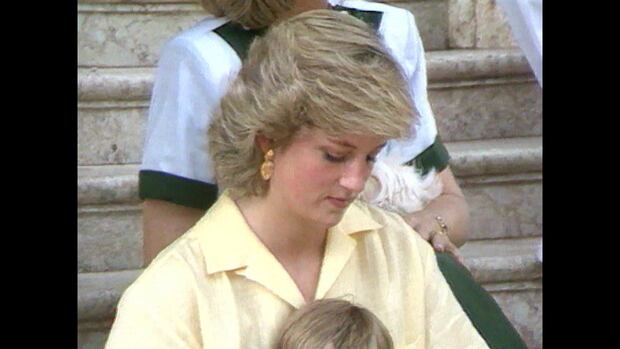
‘I am going to [die] in an accident — helicopter, plane or car crash’ | Diana: The Ultimate Truth
Close friends of Diana tell of how she always thought she would die young, either in a plane, helicopter or car crash.
Diana may have had a chance of surviving that night
In the documentary, Williams-Thomas retraces Diana’s steps in Paris, where Diana spent her final days with filmmaker Dodi Fayed in August 1997, and tracks down crash witnesses who have never spoken publicly. He also travels to the U.K. to meet an expert who prepared a report for the official British inquest into Diana’s death.
Tom Treasure, a cardiothoracic surgeon, reviews the details of the crash. “[Diana] was taken from the car, and she was conscious when they took her out,” he says. “Her circulation was in trouble, fast pulse and low blood pressure, indicating internal bleeding.”
Treasure then explains the heart injury that Diana sustained from sitting sideways without a seatbelt when the car came to an abrupt stop. He reveals that had the circumstances been different that night, allowing her rare heart injury to be identified earlier, she may have had a chance.
“It was survivable,” Treasure says in the film.
Was the driver to blame?
In 2008, the British inquest concluded that the accident was caused by the grossly negligent driving of chauffeur Henri Paul and the group of paparazzi photographers who were following the car.
French police stated that Paul was under the influence of alcohol when he took to the wheel that night. But when Williams-Thomas tracks down his close friend Claude Garrec, he insists that Paul was a responsible person who would not have put people’s lives at risk.
“So, for me, something happened that we don’t know. But Henri, in my opinion, has nothing to do with this case,” Garrec says.
While in Paris, Williams-Thomas also questions Martine Monteil, the police officer who led the French investigation into the crash, and reviews the forensic evidence. She confirms that the Mercedes had collided with another vehicle moments before entering the Pont de l’Alma tunnel, causing it to swerve, hit a curb and spin into the 13th pillar.
As for the widespread public theories that Paul’s blood samples could have been inaccurate or switched — is there any truth to these claims?
“Blood samples were taken immediately at the time of the accident and also during the autopsy,” says Monteil, who reveals that those samples indicated Paul indeed had alcohol, as well as antidepressants, in his system. “He wasn’t drunk, that’s for sure, but he had consumed alcohol.”
Was the car tampered with?
Following the French investigation, the Metropolitan police in England launched their own inquiry into Diana’s death. They commissioned three forensic and traffic collision experts to examine every element of the crash and determine if anything had been tampered with on Diana and Fayed’s vehicle. These experts come together for the first time on television in Diana: The Ultimate Truth.
“Because of all the tampering allegations, I wanted the Met police to buy or borrow an identical car,” says David Price, a forensic accident investigator who went on to compare Diana’s crashed vehicle with a second Mercedes to determine any differences.
“I was going from one to the other, checking out all the underside to look for any signs that anything had been attached to it or any signs that there had been a small explosion to disable something.”
The findings of the forensic team, along with all the other evidence gathered, may finally answer the remaining questions surrounding Diana’s death.
